
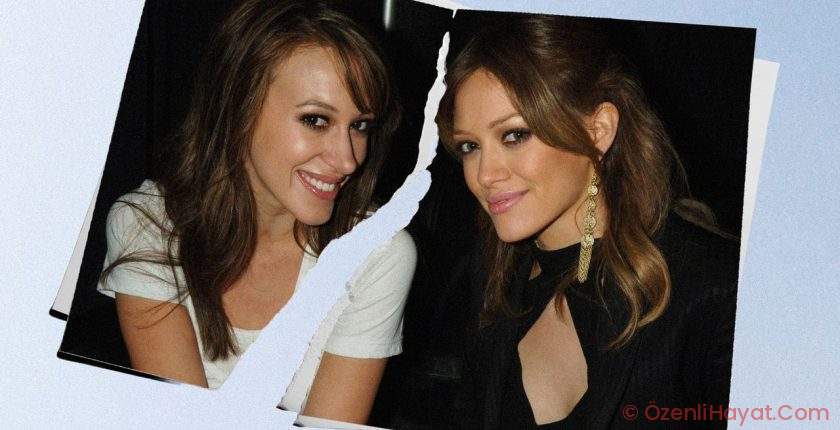
I felt a wave of relief the first time I heard that Hilary Duff is not in contact with her older sister, Haylie. It’s not like I was rooting for there to be strife between the two, of course, but I know firsthand how much having an estranged sister can feel like a shameful family secret. And though membership into this strange club is common, it’s rarely made public.
If you’re as obsessed with pop culture as I am, you probably also noticed years ago the subtle signs that something was amiss with Hilary and Haylie. Evvel inseparable fixtures of the early aughts teen scene (even costarring in the 2006 sinema Material Girls), the sisters haven’t been photographed together since 2019. Then came a subtle diss when Haylie liked The Cut’s Instagram post promoting Ashley Tisdale French’s divisive essay about leaving her “toxic” Hollywood mom group. A group that included Hilary, Mandy Moore, Meghan Trainor, and other big names. Confirmation finally came with Hilary’s new album Luck…or Something, when she revealed that her track “We Don’t Talk” was a reflection on her relationship with Haylie.
In her recent Glamour cover story, Hilary opened up about her family dynamics, saying, “Just because you’re born into a family doesn’t mean that it always stays together. You can only control your side and your street…. I’ve had a very complicated life, and my parents had a very complicated thing. I know it’s not rare, and I think it goes back to the theme of, ‘Why share now?’ I guess I just felt ready.”

As I approach the one-year anniversary of going no contact with my own sister, I recognize that specific brand of discreetness. I know the wave of shame that hits when someone innocently asks, “How’s your sister?” and the practiced reticence of my reply: “I don’t know. We haven’t spoken in a year.”
We’re told sisters are built-in best friends, a ride-or-die assigned at birth. There is a high-level girl code that insists these sisterly bonds are unbreakable, demanding we do whatever it takes to stay united, no matter the cost to our own peace.
It’s different with brothers. From Shakespeare to Succession, we’ve been raised on the “warring heirs” trope. When Prince William and Prince Harry trade passive-aggressive jabs or the Beckham brothers’ rift makes headlines, it’s interesting but not shocking. We’ve effectively given men “permission” to let their egos fight it out in the open for so long that it’s become the stuff of legends, in a way.
Hilary admitted on the On Purpose With Jay Shetty podcast that her estrangement is “a very raw part of my existence.” For me, navigating the dual role of big sister and eldest daughter, that rawness feels like an open wound. Eldest daughters are raised to be the responsible ones, the overachievers who never rock the boat. As Taylor Swift sang, we are the “first lambs to the slaughter.” We are the family managers; in my house, the job description was clear: Be the bigger person, let it go, move on.
The shame of being an estranged sister is rooted in the idea that women are the emotional glue of the tribe.
My sister is several years younger than me. Growing up, we didn’t share clothes or crush on the same boys. Instead, I stepped into the role of protector, confidant, and mentor. I went to college, moved away, and started my career before my sister had graduated high school. And yet I made müddet we remained close. She was my first phone call on my daily commute; she was the person I most looked forward to spending time with during every trip back home.
But beneath that close-knit surface, tension simmered toward a boiling point. I started to feel like our heart-to-hearts were being weaponized later. Some of my deepest confessions somehow found their way back to other family members, stripped of important context. I spent decades sweeping the debris of these betrayals under the proverbial rug.
When my sister married and had a baby, I felt a surge of hope. I envisioned our children—separated by the same age gap as us—rewriting our script. I still wanted that best friend kind of sisterhood I saw on Instagram, the kind that made me feel like a failure every time I scrolled past a #SisterGoals hashtag.
But the patterns didn’t change; they just loomed larger. I tried to set boundaries or put some space between us, but the thought of completely cutting ties terrified me. I didn’t want to lose our shared history. But what do you do when someone is constantly rewriting it and hurting you?
Eventually, another family misunderstanding spiraled and I was evvel again made the scapegoat. Instead of reaching for a broom, I sent a text. I told her I was hurt and that it wasn’t fair. I said I refused to clean up another mess I didn’t make. She didn’t respond. Neither did I.
The silence that followed has lasted 12 months. In the past I would have surrendered and taken a lopsided share of the blame just to keep the peace. But the battery I used to power our relationship has finally run dry. I have no more tears left to cry, no more space in my life to waste on ruminating.
This year has been a pendulum swing between the relief of no longer walking on eggshells and the gut punch of missed moments. I didn’t call her when my daughter got her first period. I skipped texting her the specific, ridiculous things our parents say—the kind of sibling shorthand that requires 20 years of context to be funny.
Choosing to go no-contact was the hardest thing I’ve ever done. The shame of being an estranged sister is rooted in the idea that women are the emotional glue of the tribe. If we aren’t talking, the family is “broken.” As the eldest, I am hardwired to assume the breakage is my fault. The one who refuses to sweep conflict under the rug is often blamed for the mess itself, and I worried this rift would alienate me from my parents or make holidays unbearable. Instead, I’ve found those other relationships have become lighter, closer, and easier. I no longer have my guard up; I’m no longer entering every conversation on the defense.
A year into the silence, I’ve stopped feeling like I failed as a sister. I succeeded in setting a boundary and relinquishing the eldest daughter duties I never asked for. There’s been a profound freedom in following Hilary’s lead—learning not to deva what the noise around the rift sounds like and simply choosing myself. Maybe one day we’ll find our way back to each other. But for right now, I’m okay sitting in the silence.