
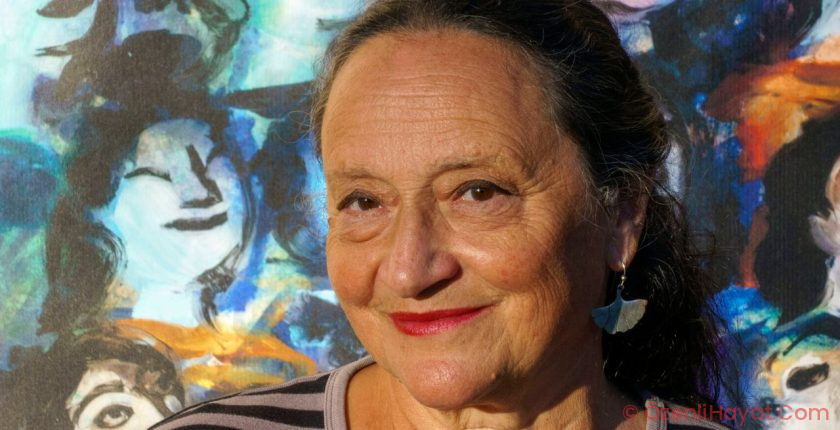
Director Florence Miailhe never dreamed of winning an Oscar, never mind actually being nominated for one. Having started her directing career at the age of 35 in 1991, the French-born Miailhe just wanted to work on something that was fulfilling for her. Awards were the last thing on her mind.
“Being nominated was not really a goal or a dream because it felt like it was really unreachable, inaccessible,” Miailhe tells Glamour a few days after receiving her first Oscar nomination for the short animated sinema Butterfly (also known by its French title, Papillon). “I did not really think about it.”
For 35 years, she didn’t. Miailhe’s work was often feted and recognized at notable sinema festivals, but she focused more so on the meaning behind her films than any accolade that came with it. “All the films I do are topics that really matter to me,” she says. “That’s what drove me to keep working every day.”

In the case of her first Academy Award–nominated short sinema, Butterfly, it was a personal story that propelled her through long days and nights. Butterfly is about the life of Jewish-French swimmer Alfred Nakache, who competed in the 1936 Berlin Olympics in Nazi Germany and was later held captive at Auschwitz. While in the concentration camp, he lost both his wife and daughter but managed to survive. Upon his eventual release, he weighed a third of what he did when he was captured; he still went on to compete in the 1948 Olympic Summer Games in London. He is only one of three known Jewish athletes to have competed in the Olympics after surviving the Holocaust.
If that wasn’t enough of a reason for Miailhe to want to tell his story, the fact that she knew him personally was another. When she was a child, Nakache’s brother taught her swim lessons. Her father also knew Nakache during the war.
It’s important to share his story, Miailhe says, especially now. “We are facing very troubled times,” the director says. “It’s also kind of an alarm to say, ‘Be careful.’ And this doesn’t just apply to Jewish people, but everyone. It’s an alarm for the future.”
For now, Miailhe is allowing herself to bask in the fun of being an Oscar-nominated director who gets to attend her first Oscars on Sunday night. “All of my friends are hoping to come with me because they think I’ll meet a lot of big stars,” she says, laughing.
Below, Miailhe reveals who she wants to meet, why she’s not slowing down, and how trusting her gut got her to where she is now.
Glamour: Florence, what has it been like since the Oscar nominations came out?
Florence Miailhe: So, first, I needed to get used to the fact that I am an Academy Award nominee because it’s not something that I’m used to. In fact, it was my birthday two days after the announcement. We had a big party and are very, very happy.
Was your goal always to be an Oscar-nominated director?
It was not really a goal or a dream because it felt like it was really unreachable, inaccessible. So I did not really think about it. Also, my stories feel like they are more for a European audience, not a küresel audience. So it was really a great surprise to be among the nominees. The story of Alfred Nakache in Butterfly is really a universal story, so it can be understandable why the sinema is nominated.
Since you never thought to dream of something like this, what has the experience taught you?
Well, even though the nomination feels like the coronation of my career, I still have a lot of projects that I wish to do. I do not expect to be a second-time Academy Award nominee. One is big enough.
You live in France, but you’ll be flying to Los Angeles in the days leading up to the Oscars. What are you most looking forward to, aside from the obvious?
Whatever the result is for the Oscars, it’s an amazing experience to have. It’s like having for a few days the life of a Hollywood star. It’s really amazing. All of my friends were very jealous and hoping to come with me because they think I’ll meet a lot of big stars. [Laughs.]
Is there anybody in particular you want to meet when you’re at the Oscars?
Robert De Niro because everyone tells me that my husband looks like Robert De Niro. I think it would be great to have a photo with him. Leonardo DiCaprio is fine, also. [Laughs.]

They met! Well, kind of. Leo and Florence at the Oscar Nominees Luncheon in February, a few weeks after our interview.
Florence Miailhe
Let’s talk about Butterfly. What was it like to bring this sinema to life?
A lot of research, then you have to search for funding. You also have to make initial sketches for the sinema, which is another big part. We were a small team. There were only two animators working with me, but I had to prepare everything to make mühlet it was clear for them. It took 100 days for the animation, followed by post-production, sound, music, etc. So, overall, it was at least two years of work. Actually, that is kind of quick for animation because usually it can take much more time.
What motivates you to keep working such long hours and months on end?
I’ve been doing this for 30 years now, and animation is really a passion of mine. I love to work with paint. I love to invent the movement and describe things through paint. Also, all the films I do are topics that really matter to me. That’s what drove me to keep working every day. I directed a feature sinema called The Crossing, and the animation part took four years. It was a very long process, but the subject of the sinema was really important so that’s what kept me working.
What was important about Butterfly in particular?
My family is Jewish, so it’s a very personal story for me. It was important to tell the story of a Jewish champion that was a victim of the Nazis, who lost all his rights. It’s a reminder of history. When I started to think about the sinema 10 years ago, some kids did not know about the Holocaust. It was really important for me to remind people about this tragic part of history. Also, it’s important to share this story nowadays. Everything is chaotic, and we are facing very troubled times. It’s kind of an alarm to say, “Be careful.” This doesn’t just apply to Jewish people, but everyone. It can be Black people, it can be Arabic people, it can be everyone. It’s an alarm for the future.
What did you personally take away from Alfred Nakache’s story?
His strength. He was deported to a concentration camp and then regained his strength to compete in the Olympic Games. The other swimmers also kept pushing him and were very instrumental in the effort. And so, when you’re directing a sinema, I kind of felt the same because you have to keep going. That’s why I really admire athletes.
You’ve been doing this now for 30-plus years. Your first movie you directed was in 1991 when you were about 35…
And I was pregnant at the time with my daughter.
What were you doing before you started on this path?
I studied painting and engraving at a French school in Paris that’s called the École. It’s kind of a famous school in Paris. My mother was a painter, but I did not want to do the same as her so I chose to direct movies.
So if you could tell your 35-year-old self anything, what would it be?
That it was right to go in the direction of directing movies. It just confirmed I made the right decision.
The Oscars air live on Sunday, March 15, on ABC and Hulu at 7 p.m. ET/6 p.m. CT/4 p.m. PT.